Hip fractures: Garden, the blood supply of the femoral head and treatment under NICE CG124
Hip fractures for FRCS (Tr & Orth): Garden and Pauwels, femoral head blood supply, NICE CG124 and its 2023 THR criteria, cemented implants, screw or nail.
The hip capsule attaches to the intertrochanteric line in front but only halfway along the neck behind. Fractures inside it (subcapital and transcervical) behave very differently from those outside it (basicervical, trochanteric and subtrochanteric), because of the blood supply to the head.
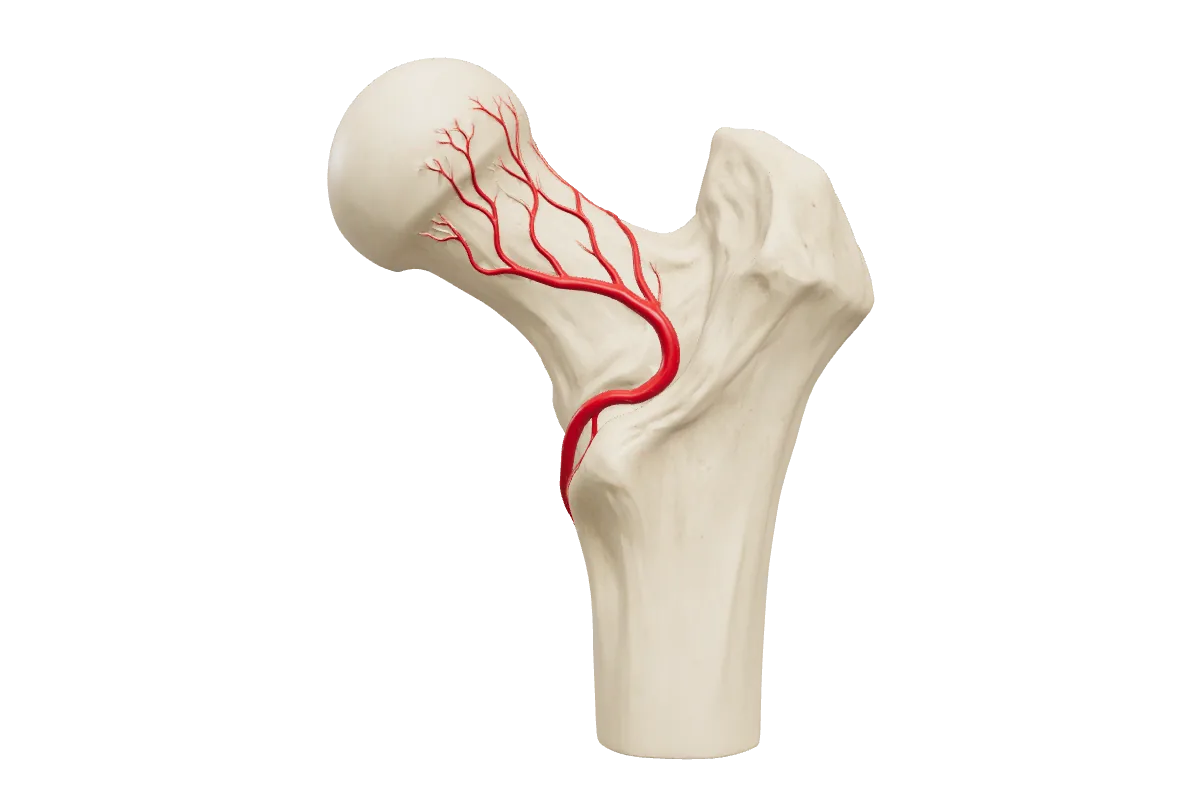
Medial femoral circumflex artery. Its deep branch runs behind the neck and gives the posterosuperior retinacular (lateral epiphyseal) arteries, which climb beneath the synovium along the neck to supply most of the weight-bearing head. A displaced intracapsular fracture tears them.
Lateral femoral circumflex artery. Supplies the front of the neck and contributes little to the head in adults.
Artery of the ligamentum teres. A branch of the obturator artery; small and variable in adults, and not enough to keep the head alive.
Intraosseous supply. Metaphyseal vessels crossing from the neck, divided by any intracapsular fracture.
Interactive 3D · Blood supply of the femoral head. Interactive 3D model: the retinacular branches of the medial femoral circumflex artery running up the back of the femoral neck.Open full screen
Classification
The Garden classification (1961). Interobserver agreement is poor between individual grades but good for undisplaced versus displaced, which is the grouping that drives treatment.
Garden
Description
Practical group
I
Incomplete or valgus-impacted fracture
Undisplaced
II
Complete fracture, undisplaced
Undisplaced
III
Complete fracture, partially displaced; trabeculae of head and acetabulum out of line
Displaced
IV
Complete fracture, fully displaced; head trabeculae realigned with the acetabulum
Displaced
Pauwels classified intracapsular fractures by the angle of the fracture line to the horizontal: under 30° (type I), 30–50° (type II) and over 50° (type III). The more vertical the line, the more shear and the higher the risk of non-union, which matters most in young patients after high-energy injury.
Extracapsular fractures are trochanteric or subtrochanteric. The AO/OTA system divides trochanteric fractures into simple pertrochanteric (A1), multifragmentary pertrochanteric with an incompetent lateral wall (A2) and intertrochanteric, including reverse oblique, fractures (A3). Subtrochanteric fractures lie within about 5 cm below the lesser trochanter. A basicervical fracture is extracapsular in behaviour and is treated like a trochanteric fracture.
Before theatre
A Hip Fracture Programme from admission. NICE asks for orthogeriatric, ward-based care that includes rapid optimisation for surgery, early identification of rehabilitation goals and continued orthogeriatric and multidisciplinary review.
Analgesia. Paracetamol and opioids, with a nerve block (such as a fascia iliaca block) if they are not enough. NICE is explicit that nerve blocks are not a substitute for early surgery.
Timing. Surgery on the day of, or the day after, admission. Delay is justified only by a correctable problem, such as uncorrected anaemia, fluid or electrolyte disturbance, anticoagulation, or an arrhythmia or heart failure that can be treated quickly.
Anaesthesia. Spinal or general. In REGAIN (Neuman, NEJM 2021) spinal anaesthesia did not improve survival or recovery of walking at 60 days compared with general anaesthesia.
Intracapsular fractures
Situation
Usual treatment
Evidence or guidance
Undisplaced, any age
Internal fixation in situ: cancellous screws or a sliding hip screw
FAITH (Lancet 2017): similar reoperation rates overall; NICE has a research recommendation for this group
Displaced, older or frail
Cemented replacement arthroplasty
NICE CG124: offer replacement arthroplasty; use cemented implants
Displaced, fit and independent
Total hip replacement
NICE CG124 (2023) criteria; HEALTH (NEJM 2019)
Displaced, physiologically young
Urgent anatomical reduction and internal fixation
Quality of reduction is the main modifiable factor for non-union and avascular necrosis
NICE CG124 offers replacement arthroplasty, either total hip replacement or hemiarthroplasty, for displaced intracapsular fractures. The 2023 update suggests considering total hip replacement rather than hemiarthroplasty for people who were able to walk independently out of doors with no more than the use of a stick, who have no condition or comorbidity that makes the procedure unsuitable, and who are expected to carry out activities of daily living independently beyond two years. The older wording about cognitive impairment was replaced by this emphasis on function.
HEALTH (Bhandari, NEJM 2019): total hip arthroplasty did not reduce secondary procedures at 24 months compared with hemiarthroplasty. Function and quality of life were slightly better with total hip arthroplasty, and dislocation was commoner.
Cement. NICE asks for cemented implants. In WHiTE 5 (Fernandez, NEJM 2022) cemented hemiarthroplasty gave better quality of life at four months than a modern uncemented design, with similar mortality and fewer periprosthetic fractures.
Stem design. The 2023 update asks hospitals to use a single type of cemented femoral component for hemiarthroplasty, choosing between equivalent designs on cost, training and team familiarity.
Approach. NICE suggests considering an anterolateral rather than a posterior approach for hemiarthroplasty.
Bone cement implantation syndrome. Hypoxia, hypotension or cardiac arrest at cementation. The 2015 AAGBI/BOA/BGS safety guideline covers identifying high-risk patients, team briefing, careful cementing technique and close monitoring.
Extracapsular fractures
Trochanteric fractures. NICE asks for extramedullary implants such as a sliding hip screw in preference to an intramedullary nail. The exception is the reverse oblique fracture involving the lesser trochanter, in which the screw would slide along the fracture line; it is nailed. An incompetent lateral wall also favours a nail, to prevent excessive collapse.
Subtrochanteric fractures. NICE asks for an intramedullary nail. The proximal fragment is flexed by iliopsoas, abducted by the gluteal muscles and externally rotated, while the adductors pull the shaft medially; a load-sharing nail with a short lever arm resists these forces better than a plate.
Tip–apex distance. The sum of the distances from the tip of the lag screw to the apex of the femoral head on the AP and lateral views, corrected for magnification. Baumgaertner (JBJS Am 1995) found that cut-out rose steeply above 25 mm.
Atypical femoral fractures. A transverse, non-comminuted subtrochanteric or shaft fracture with lateral cortical thickening (beaking), linked to long-term bisphosphonate use. Image the other femur, nail the fracture and stop the bisphosphonate.
Pathological fractures. Image the whole femur, biopsy if there is no known primary, and use a long nail or a long-stemmed arthroplasty to protect the bone.
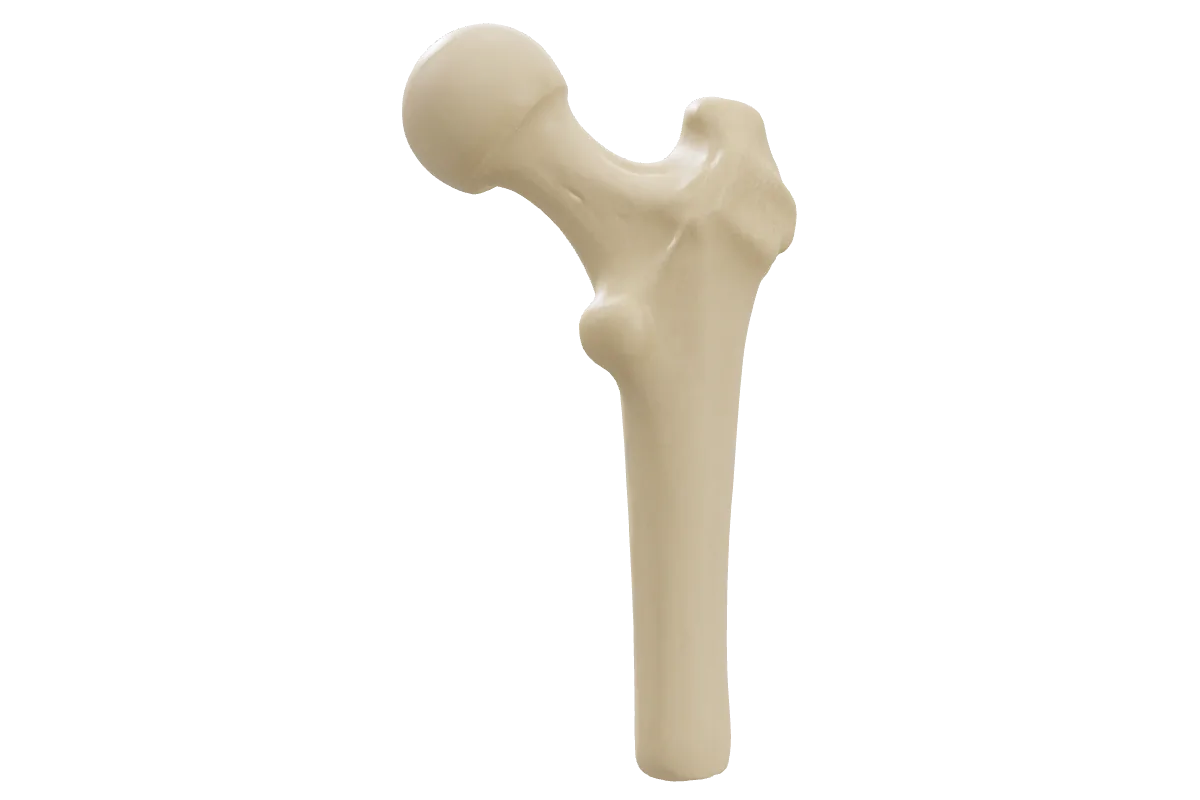
Interactive 3D · Proximal femur. Interactive 3D model of the proximal femur: neck, greater and lesser trochanters, and the subtrochanteric region.Open full screen
After surgery
Weight bearing. NICE asks surgeons to operate so that patients can bear full weight, without restriction, immediately after surgery.
Mobilisation. A physiotherapy assessment and, unless medically or surgically contraindicated, mobilisation on the day after surgery; then mobilisation at least once a day with regular physiotherapy review.
Bone health and falls. Assess bone health and falls risk before discharge, and start secondary fracture prevention.
Audit. In England, Wales and Northern Ireland every hip fracture is recorded in the National Hip Fracture Database, which publishes each hospital’s performance against key indicators such as prompt surgery and orthogeriatric review.
A 64-year-old woman has radiographically severe osteoarthritis of the hip. Pain wakes her nightly and has stopped her working, despite a supervised exercise programme, weight-management support and oral analgesia. Her body mass index is 41 kg/m² and she smokes.
According to NICE guidance, what is the most appropriate advice to her general practitioner about referral?
How sure are you?
Explanation
NICE NG226 advises referral for consideration of joint replacement when joint symptoms substantially affect quality of life and non-surgical management has been ineffective or is unsuitable, and that referral should come before prolonged, established functional limitation and severe pain. It states explicitly that people should not be excluded from referral because of age, sex or gender, smoking, comorbidities, or overweight or obesity, and that scoring tools should not be used to set thresholds. Body mass index limits are therefore not a reason to delay referral, although weight and smoking are then addressed as risks during shared decision making. A steroid injection gives only short-term relief and is not a required step. Reference: NICE NG226, Osteoarthritis in over 16s (2022).
Which artery is most important to the femoral head in adults?+
The medial femoral circumflex artery. Its deep branch gives the posterosuperior retinacular (lateral epiphyseal) vessels, which run along the back of the neck and are torn by a displaced intracapsular fracture.
When should a total hip replacement be offered for a hip fracture?+
NICE CG124 (2023) suggests considering total hip replacement rather than hemiarthroplasty for a displaced intracapsular fracture in people who walked independently outdoors with no more than a stick, have no condition that makes the procedure unsuitable, and are expected to remain independent for more than two years.
Should hemiarthroplasty be cemented?+
Yes. NICE asks for cemented implants, and the WHiTE 5 trial found better early quality of life with cemented hemiarthroplasty than with a modern uncemented design. Cementing is done with the precautions of the 2015 safety guideline on bone cement implantation syndrome.
Why are subtrochanteric fractures nailed rather than fixed with a sliding hip screw?+
The region carries high bending forces and strong deforming muscle pulls. An intramedullary nail is load-sharing and has a shorter lever arm, so it controls the fracture better; NICE recommends a nail for subtrochanteric fractures.
What is the tip–apex distance?+
The sum of the distances from the tip of the lag screw to the apex of the femoral head on the AP and lateral radiographs. Keeping it below 25 mm reduces the risk of the screw cutting out of the head.
Garden RS. Low-angle fixation in fractures of the femoral neck. J Bone Joint Surg Br 1961;43-B(4):647–663.
Pauwels F. Der Schenkelhalsbruch: ein mechanisches Problem. Stuttgart: Enke; 1935.
Baumgaertner MR, Curtin SL, Lindskog DM, Keggi JM. The value of the tip-apex distance in predicting failure of fixation of peritrochanteric fractures of the hip. J Bone Joint Surg Am 1995;77(7):1058–1064.
FAITH Investigators. Fracture fixation in the operative management of hip fractures (FAITH): an international, multicentre, randomised controlled trial. Lancet 2017;389(10078):1519–1527.
HEALTH Investigators; Bhandari M, Einhorn TA, Guyatt G, et al. Total hip arthroplasty or hemiarthroplasty for hip fracture. N Engl J Med 2019;381(23):2199–2208.
Fernandez MA, Achten J, Parsons N, et al. Cemented or uncemented hemiarthroplasty for intracapsular hip fracture. N Engl J Med 2022;386(6):521–530.
Neuman MD, Feng R, Carson JL, et al. Spinal anesthesia or general anesthesia for hip surgery in older adults. N Engl J Med 2021;385(22):2025–2035.
Griffiths R, White SM, Moppett IK, et al. Safety guideline: reducing the risk from cemented hemiarthroplasty for hip fracture 2015. Anaesthesia 2015;70(5):623–626.
Written for revision in the FRCS (Tr & Orth) style under our editorial standards. It is not clinical advice: always confirm against current guidance. Spotted an error? Tell us.